Connect your EFS (WEX) account to OpenRoad TMS and your drivers' EFS fuel purchases and cash advances are imported automatically. You can also let OpenRoad create and assign your EFS cards, and put a driver's card on hold while the driver has no load.
Before you begin
- Ask your EFS representative to deliver your daily transaction file by SFTP, and to name the file with the letters EXT (for example EXT_188862_040725). OpenRoad imports only files with EXT in the name. EFS (WEX) emails the SFTP host, username and password to your assigned contact.
- If you use EFS Money Codes, ask EFS to deliver the money codes file (a name containing TCH and Moneycodes, for example TCH-Moneycodes-040925) to the same SFTP folder.
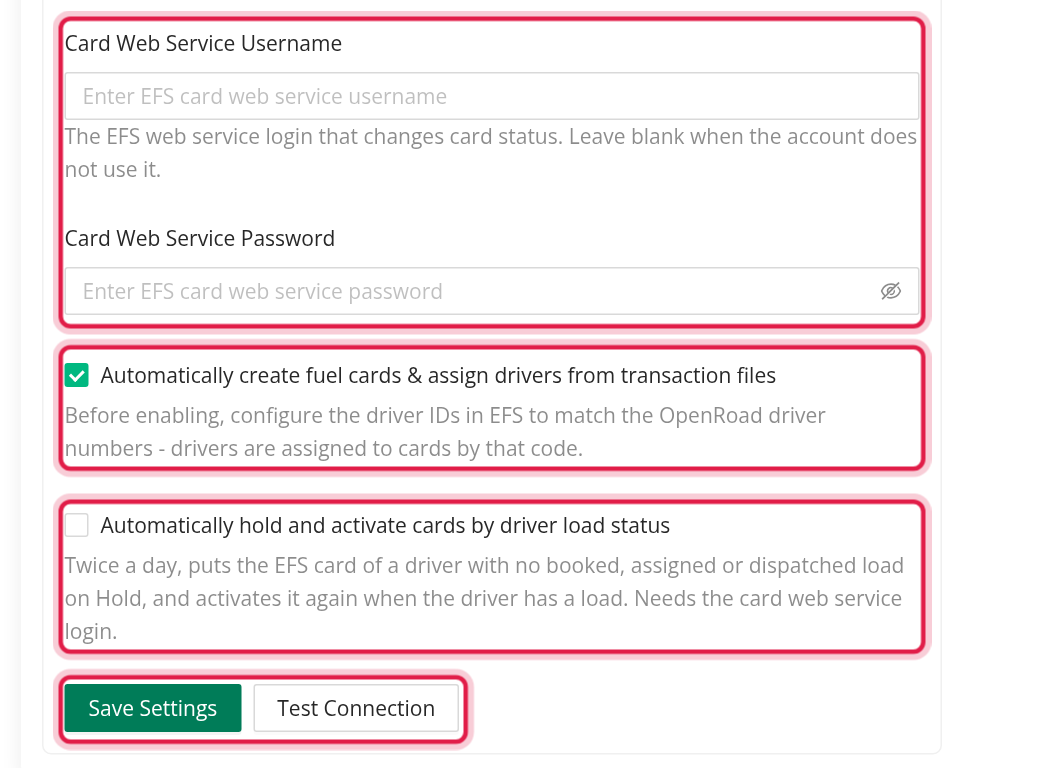
- Optional: the EFS card web service login (Card Web Service Username and Card Web Service Password). You only need it if you want OpenRoad to hold and activate cards (Part 4). Ask EFS for it.
- Your drivers must exist in OpenRoad. See "Adding a driver".
send EFS passwords only through the settings page or to OpenRoad Support. Never post them in chat messages or tickets that other people can see.
Part 1: Connect EFS
- Go to Settings → Integrations → EFS.
- In the Configuration card fill in EFS Host, EFS Username and EFS Password. All three are required.
- Click Test Connection. If it fails, check the values with EFS.
- Set Integration Status to Enabled. OpenRoad runs the connection check first. If the check fails, the status stays Disabled.
- Click Save Settings.
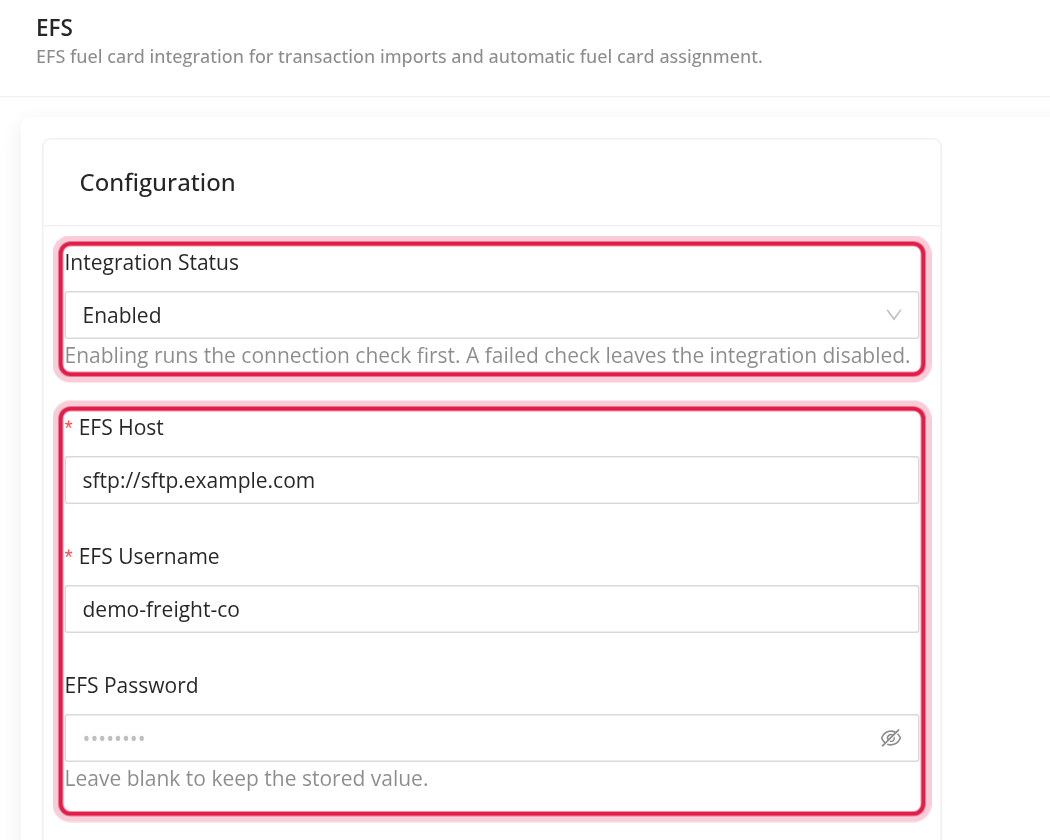
Once a password is saved, OpenRoad never shows it again. If you leave the field blank when saving, the saved password stays.
if the host begins with sftp://, OpenRoad checks an SFTP connection and reads the folders
/ and /out. Otherwise it uses plain FTP. EFS has moved its customers to a new SFTP server; use the host your EFS contact gave you.Part 2: How the import works
- OpenRoad checks for new files about every 2 hours.
- Only files with EXT in the name are imported as fuel transactions. Files named TCH and Moneycodes are imported as money codes. Other files are ignored.
- Each transaction in a file is saved once. If EFS sends the same transaction again with changes, the saved transaction is updated.
- The transaction is linked to the driver who has that card assigned on the date and time of the purchase. If the card is not assigned to a driver for that time, no driver is shown.
- Imported transactions appear on Fuel, Fuel Transactions, and the raw file rows on Fuel, EFS Fuel Cards. Money codes appear on Fuel, Accessorial Codes.
Part 3: Cards and drivers
Choose one of these:
Let OpenRoad create and assign the cards. Tick Automatically create fuel cards & assign drivers from transaction files.
- OpenRoad creates each new card it finds in a transaction file with the status Active.
- It assigns the card to the driver whose driver number in OpenRoad matches the driver ID on the EFS transaction (leading zeros and letter case are ignored). If the card shows up under another driver, the earlier assignment is closed just before the transaction and the card is assigned to the new driver from the transaction time.
- Before you tick it, set the driver IDs in EFS to match your OpenRoad driver numbers.
Register cards yourself. Add the cards and assign them to drivers on the Fuel Cards page. See "Fuel Cards page".
Part 4: Hold cards when a driver has no load
Tick Automatically hold and activate cards by driver load status. This needs the Card Web Service Username and Card Web Service Password.
- OpenRoad checks your Active and Hold EFS cards that are assigned to a driver. This runs three times a day.
- A card is set to Active when its driver has a stop on a load that is booked, assigned or in progress, or when the driver's team partner has one. Otherwise it is put on Hold.
- The card's status in OpenRoad follows the status in EFS.
Frequently asked questions
Was this article helpful?
That’s Great!
Thank you for your feedback
Sorry! We couldn't be helpful
Thank you for your feedback
Feedback sent
We appreciate your effort and will try to fix the article